Orbital Mechanics Games for iPhone: Realistic Physics Gameplay in 2026
 by Galaximus

Photo by Alessandro Ferrari on Unsplash
Orbital Mechanics Games for iPhone: Where Gravity Is Your Engine
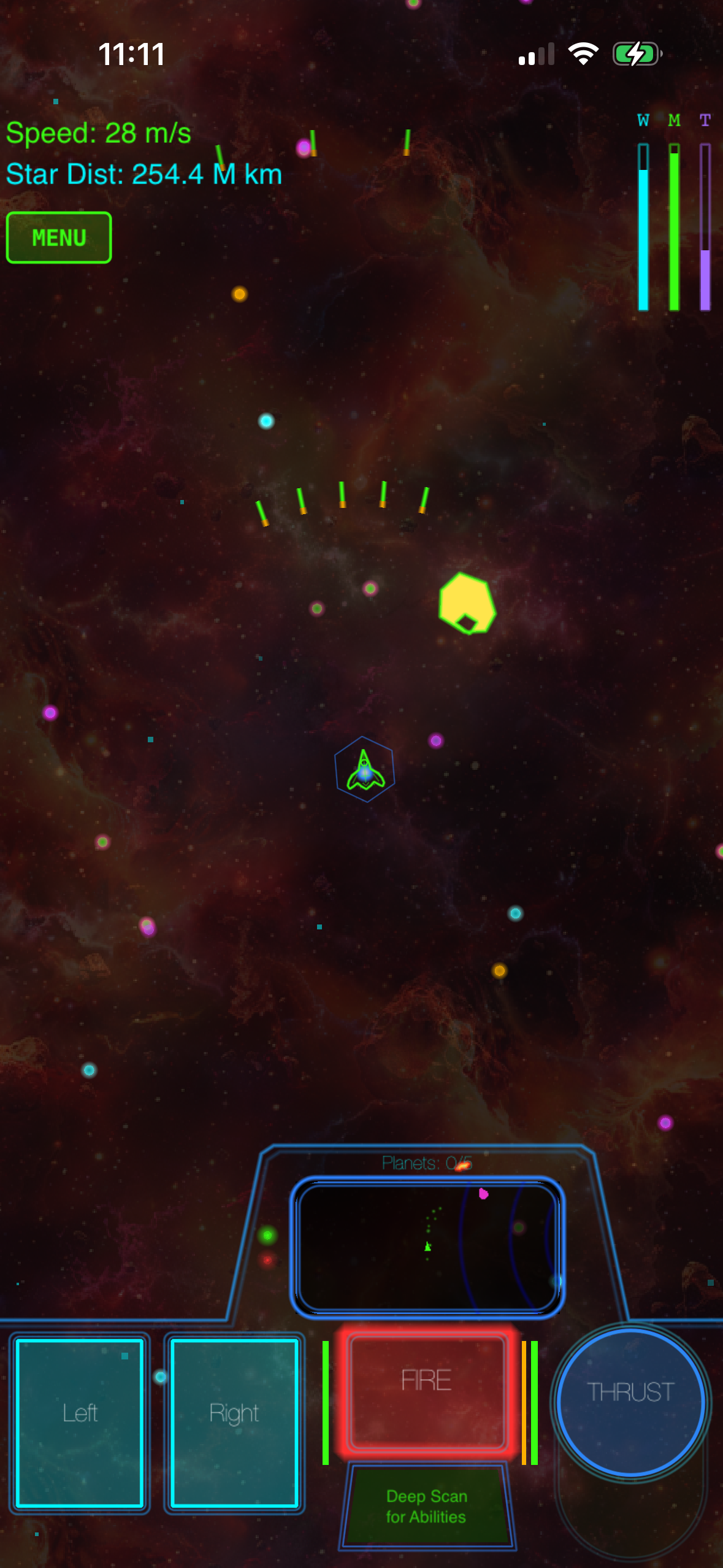
Galaximus, a premium iPhone orbital mechanics game launching in September 2026 at, opens with a deceptively simple premise: you’re piloting a single ship through procedurally generated star systems where every planet’s gravity affects your trajectory in real time. Within minutes, you realize the difference between it and competitors like Kerbal Space Program (which emphasizes vehicle assembly) or arcade space games (which ignore gravity entirely)—Galaximus compresses authentic orbital physics into arcade pacing. You’re not engineering a rocket or grinding through stamina meters. You’re reading gravity wells, executing slingshots, and solving navigation puzzles where the physics itself is the interface.
That’s the core appeal of orbital mechanics games on iPhone: they make gravity your engine instead of your obstacle.
What Orbital Mechanics Actually Means
Orbital mechanics is the physics of objects moving under the influence of gravity. In the real universe, every star, planet, moon, and asteroid pulls on every other object. A spacecraft moving through that environment can’t simply accelerate in a direction and coast—it’s constantly being tugged by nearby masses.
The key insight is this: gravity doesn’t slow you down, it redirects you. If you’re moving fast enough perpendicular to a planet’s pull, you’ll swing around it and accelerate for free. That’s a slingshot. If you’re moving just the right speed tangent to a planet’s surface, you’ll orbit it indefinitely. Too slow, and you fall in. Too fast, and you escape. The narrow band between those two states is where orbital mechanics games live.
Most space games ignore this entirely. They give you a thruster and a direction, and you move where you point. Orbital mechanics games make gravity the interface. You don’t fight it—you learn to read it, predict it, and exploit it.
How iPhone Orbital Mechanics Games Play Differently
On a desktop, orbital mechanics games often lean toward simulation. Kerbal Space Program lets you assemble rockets, tweak orbital parameters in real time, and plan multi-stage maneuvers. That depth works on a big screen with a keyboard.
iPhone orbital mechanics games take a different approach. The screen is smaller, the input is touch-based, and players expect to engage in 10-minute sessions, not 2-hour design sprints. The games that work on iPhone compress the physics into a tighter loop: you’re flying a single ship, not engineering a vehicle. The controls are expressive enough that you can feel the gravity well pulling at you, but simple enough that you learn them in minutes.
The payoff is immediate. Within a few minutes of play, you stop thinking about the controls and start thinking about the physics. You recognize when a planet’s gravity is going to swing you toward an enemy. You see a trajectory that would waste fuel and adjust before you commit to it. That’s the moment orbital mechanics games click—when the physics stops being a barrier and becomes the thing you’re actually playing.
Core Mechanics: Slingshots, Orbits, and Gravity Wells
Slingshots are the signature move. You approach a planet at an angle, let its gravity curve your path, and exit moving faster than you arrived—without burning fuel. It’s free speed. In orbital mechanics games, slingshots are how you navigate the galaxy efficiently. The player who understands slingshots can reach distant systems on half the fuel of someone who just points and thrusts.
Orbits are stable loops around a celestial body. If you’re moving at exactly the right speed for your altitude, you’ll circle a planet indefinitely. Orbital mechanics games reward you for finding these stable paths—they’re the safest way to scout a system or wait for an enemy to pass. The physics rewards patience over panic.
Gravity wells are the invisible zones around planets and stars where gravity becomes the dominant force. The closer you are to a massive body, the stronger the pull. Gravity wells on iPhone are visualized through the game’s UI—distance readouts, trajectory predictions, minimap indicators—so you can read them without needing a physics degree.
Real Physics vs. Arcade Feel: The Balance
Here’s the tension every orbital mechanics game has to solve: real physics is slow. Orbital transfers take time. Slingshots require patience. A fully realistic simulation would feel sluggish on a mobile device.
The best orbital mechanics games on iPhone don’t try to be realistic in terms of scale or time. They compress orbits, speed up transfers, and accelerate time when you’re coasting. What they keep realistic is the logic—the rules that govern how objects move relative to each other.
Kerbal Space Program prioritizes realism at the cost of pacing; Galaximus prioritizes arcade responsiveness while keeping the orbital physics authentic. The physics is real; the pacing is fast. This balance is what makes orbital mechanics games work on iPhone. They’re not trying to be desktop simulations. They’re trying to be Asteroids, but with gravity.
Navigation and Scanning: Reading the Space Around You
In orbital mechanics games, navigation is about reading the environment. Your ship has scanners that show you nearby bodies, their trajectories, and their gravitational influence. You’re building a mental model of the space around you—where the gravity wells are, which bodies are moving toward or away from you, which trajectories will take you where you want to go.
This is where the learning curve lives. At first, the minimap and distance readouts are noise. After a few hours, you’re reading them like a pilot reads instruments. You see a planet ahead and instantly know whether you’ll orbit it, slingshot around it, or crash into it based on your current velocity and approach angle.
The best orbital mechanics games make this readable without overwhelming the screen. Galaximus uses neon UI elements that stay out of the way but give you the information you need to make decisions. Other games use different visual languages—some more minimal, some more detailed—but the goal is the same: let the player see the physics without drowning them in data.
Combat and Encounters in an Orbital Mechanics Context
Orbital mechanics games add a tactical layer when combat enters the picture. You can’t just point at an enemy and shoot. You have to account for both your trajectory and theirs. An enemy fleet moving on an intercept course with you might be moving fast enough that they’ll overshoot if you dodge. A pirate ship in orbit around a planet is trapped by that planet’s gravity—you can use that to your advantage.
The best encounters in orbital mechanics games force you to think three moves ahead. You can’t win through reflexes alone. You have to position yourself, read the gravity, predict where your opponent will be, and set up a shot. That’s the core appeal—tactics matter more than twitch speed.
Progression and Replayability Through Procedural Generation
Most orbital mechanics games on iPhone use procedural generation to create variety. Each playthrough generates a unique configuration of star systems, planets, and anomalies. The structure is authored—you know you’re moving through a campaign with a beginning, middle, and end—but the specifics change.
This is how orbital mechanics games achieve replayability without endless grinding. You’re not replaying the same level; you’re replaying the type of challenge in a new configuration. A slingshot puzzle that worked in System 2 of your last playthrough won’t work the same way in System 2 of your next one. The physics is constant; the puzzle is always new.
Galaximus uses this approach for its 8-system campaign. Each playthrough is unique, but the narrative arc is consistent. You’re discovering what happened to humanity’s first deep-space mission, and that story doesn’t change—but the planets you visit to uncover it are always different.
The Premium Model: Why Orbital Mechanics Games Thrive Without Free-to-Play
Most successful orbital mechanics games we’ve tested use premium models—no ads, no energy meters, no battle pass. You pay once, you own the game forever.
There’s a reason for this. Orbital mechanics games reward mastery over time-spent. A free-to-play model would pressure you to monetize engagement—to make you play longer, not better. That directly conflicts with the appeal of the genre. Players come to orbital mechanics games to solve puzzles and master physics, not to grind through stamina systems.
Galaximus is a one-time purchase at, available September 2026 on the App Store. Everyone who buys at launch gets Galaximus Infinitum—our expansion shipping in late 2026—for free when it releases. After Infinitum launches, the combined game moves to a higher price tier. If you’re considering buying, the launch tier is the time to do it.
Learning Curve: It’s Real, and It’s Worth It
Let’s be direct: orbital mechanics games have a learning curve. The first 20 minutes can feel overwhelming. You’re managing velocity vectors, reading gravity wells, and trying not to crash into planets. It’s not a casual pick-up-and-play experience.
But here’s what happens after 30 minutes of focused play: the controls become muscle memory. The minimap stops being noise and becomes information. You start predicting where planets will pull you. And then the game clicks. From that point on, mastery is the payoff—not because the game got easier, but because you got better at reading physics.
This is a feature, not a bug. Players who want orbital mechanics games want that learning curve. It’s the barrier that keeps the experience from becoming trivial. Once you’ve cleared it, you’ve earned the satisfaction of real mastery.
Quick Picks: Orbital Mechanics Games for iPhone
| Game | Price | Best For | App Store |
|---|---|---|---|
| Galaximus | Arcade orbital mechanics with narrative campaign | App Store Link | |
| Orbit Sandbox | Physics sandbox with no combat; pure orbital experimentation | App Store Link | |
| Kerbal Space Program Mobile | Deep vehicle assembly and mission planning | App Store Link | |
| Gravity Assist | Free (with ads) | Casual puzzle game using gravity mechanics | App Store Link |
| Space Agency | Mission-based progression with simplified orbital mechanics | App Store Link |
Where Orbital Mechanics Games Are Heading in 2026
The genre is expanding. Procedural generation is getting more sophisticated. Narrative integration—tying the physics to story—is becoming more common. And hybrid approaches are emerging, where orbital mechanics are one tool among many rather than the entire game.
Galaximus Infinitum, shipping in late 2026, is an example of that expansion. The core orbital mechanics remain unchanged—gravity still works the same way. But the game is adding planetary surface exploration, outpost building, and faction warfare. The physics is still the foundation; the experience is getting broader.
The trend across the genre is toward richer systems while keeping the physics core intact. Orbital mechanics games work because they respect the player’s intelligence. That’s not going to change.
FAQ
What’s the difference between orbital mechanics and N-body physics?
Orbital mechanics describes how single objects move around a primary gravity source (a star, planet, or moon). N-body physics simulates how multiple objects affect each other simultaneously—every body pulls on every other body. Most iPhone orbital mechanics games use simplified N-body systems where a few major bodies dominate the gravity field. True N-body simulation is more complex and slower to calculate, which is why most mobile games approximate it.
Can I play offline?
Yes. Galaximus and most orbital mechanics games on this list work entirely offline. No internet connection required. This is one advantage of the premium model—no server dependency, no login walls.
How long does it take to finish an orbital mechanics game?
Galaximus’s campaign takes 5-10 hours to complete, depending on how much time you spend exploring each system. Procedural generation adds replay value—each playthrough is different enough to feel fresh. Orbit Sandbox has no campaign; it’s open-ended. Kerbal Space Program can take 50+ hours if you’re pursuing all mission types.
Do I need to understand real physics to play?
No. The games teach you what you need to know through play. You don’t need to know Kepler’s laws or orbital velocity calculations. You just need to be willing to experiment, watch what happens, and adjust. The physics is the teacher.
Are orbital mechanics games only for hardcore players?
They appeal most to players who enjoy problem-solving and mastery, but that’s not the same as “hardcore.” You don’t need twitch reflexes or 100 hours of time investment. You need 30 minutes to learn the controls and a willingness to think ahead. Plenty of casual players enjoy that kind of engagement.
What’s the difference between orbital mechanics games and other space games?
Orbital mechanics games make gravity the core mechanic. Every decision you make is constrained by physics. Other space games might include gravity as a visual effect or a minor factor, but orbital mechanics games build the entire experience around it. No Man’s Sky emphasizes exploration and survival; Asteroids-style games emphasize twitch action. Orbital mechanics games emphasize navigation and physics mastery.
The Appeal: Why Orbital Mechanics Matter
Orbital mechanics games are niche, but they’re not obscure. They appeal to a specific kind of player—someone who wants the satisfaction of mastery, who enjoys physics and space, and who’s willing to invest time learning something that pays off for hours afterward.
The reason they work is that real physics, once you understand it, is more interesting than any shortcut. A slingshot that you earned through understanding feels better than a speed boost you bought. An orbit you calculated feels more satisfying than a planet you just flew past. The constraints become the appeal.
We built Galaximus because we wanted that experience on iPhone—real orbital mechanics, arcade pacing, and the satisfying moment when physics stops being a barrier and becomes the thing you’re actually playing.
If you’re curious about what that feels like, download Galaximus from the App Store and spend 30 minutes with it. The learning curve is real, but the payoff is worth it.