Top-Rated Paid Space Games iPhone 2026
 by Galaximus
The Best Paid Space Games for iPhone in 2026
Affiliate Disclosure: I built Galaximus and have a financial stake in its success. This article recommends it alongside two other games. I’ve disclosed this upfront so you can weigh my perspective accordingly.
The premium mobile gaming market has shrunk. Free-to-play dominates the App Store, energy meters and battle passes are standard, and finding a complete game you buy once and own forever feels increasingly rare. If you’re looking for paid space games on iPhone that actually deliver a full experience without monetization schemes, the landscape has consolidated around a few standout titles that respect your time and money.
Here’s what’s actually worth buying.
What Makes a Premium Space Game Worth Playing in 2026
The paid space game market on iPhone has two distinct camps: arcade-action games where physics is the interface you learn to master, and narrative-driven exploration games where you’re uncovering a story across star systems.
The difference matters. If you want twitch reflexes and gravity-based puzzle-solving, you’re looking at one type of game. If you want to sit with a campaign, make choices, and watch a story unfold, you’re looking at another. Both are legitimate. Both are rare in a free-to-play world.
The other defining factor is completeness. A premium game in 2026 should ship with a beginning, middle, and end — not a soft launch that waits two years for meaningful content. You’re paying upfront. The game should be worth that from day one.
Orbital Mechanics: The Real Physics Difference
Most space games fake gravity for accessibility. They simulate the look of space — planets, asteroids, the void — but they don’t simulate the physics of it. Your ship moves where you tell it to move. Gravity is window dressing.
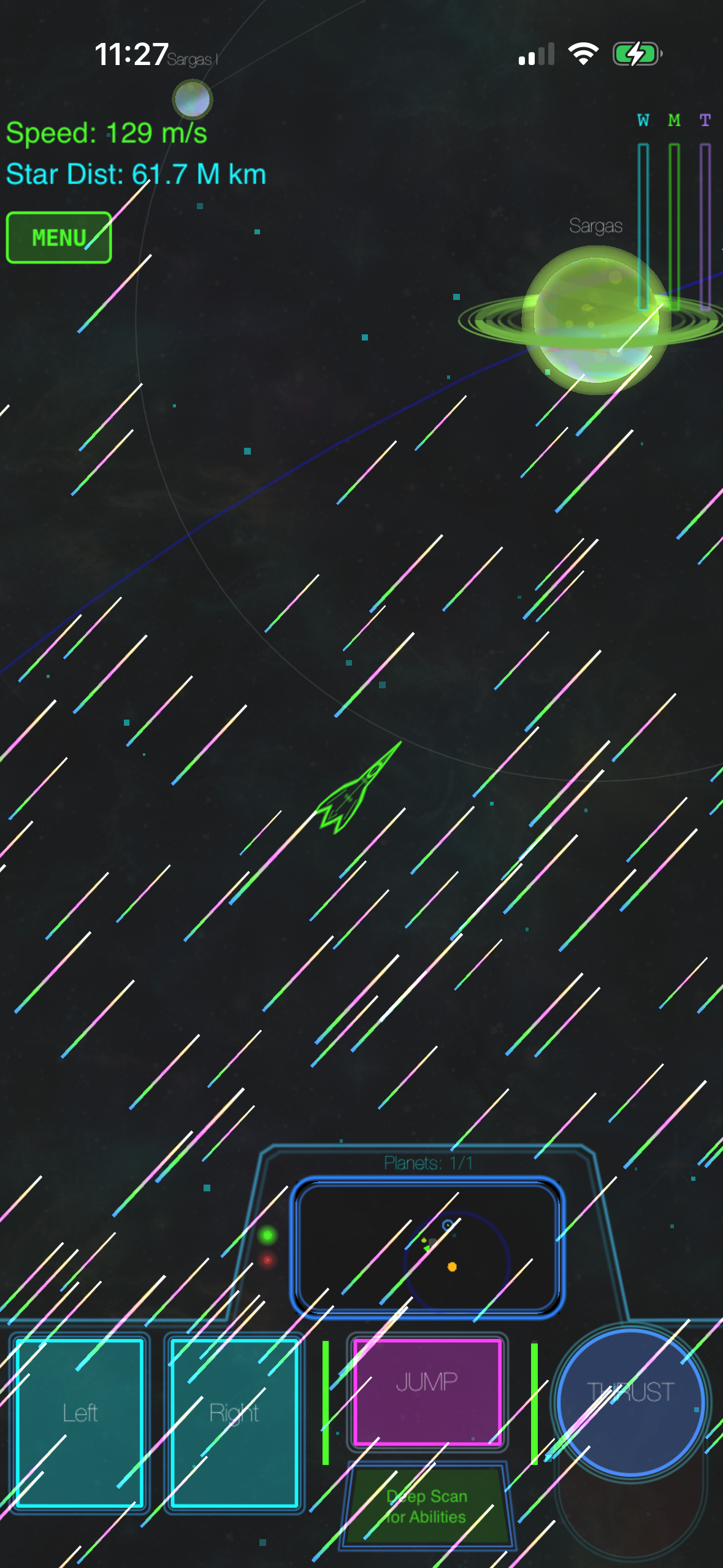
Real orbital mechanics change the game entirely. When every celestial body’s gravity affects every other body in real time, positioning becomes strategy. A slingshot maneuver — using a planet’s gravity well to gain speed for free — isn’t a special ability. It’s physics. You learn to read the gravity field the way a surfer reads a wave.
Three of the paid space games on iPhone right now actually do this. Most don’t. If orbital mechanics matter to you, that’s the filter that cuts the list down fast.
Galaximus: Arcade Action with Real Gravity
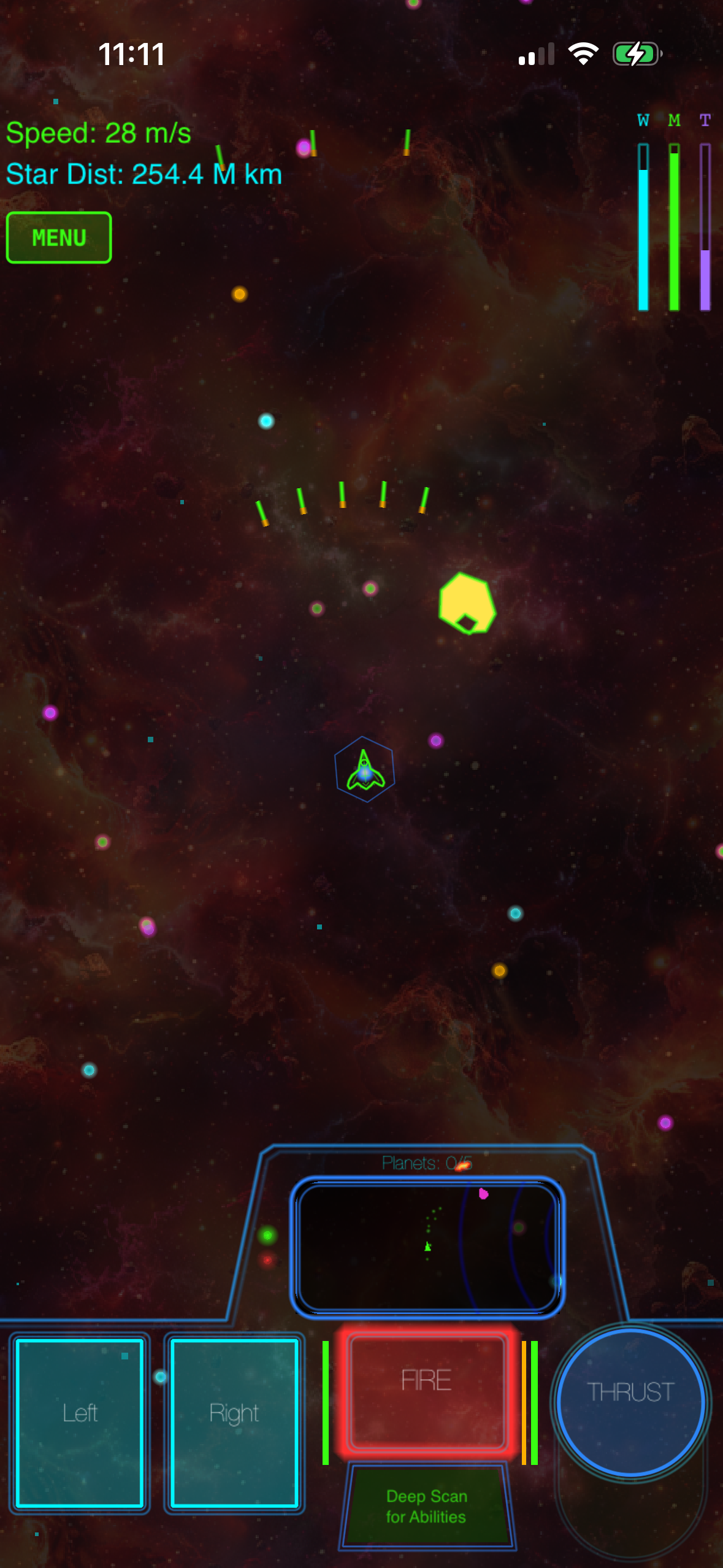
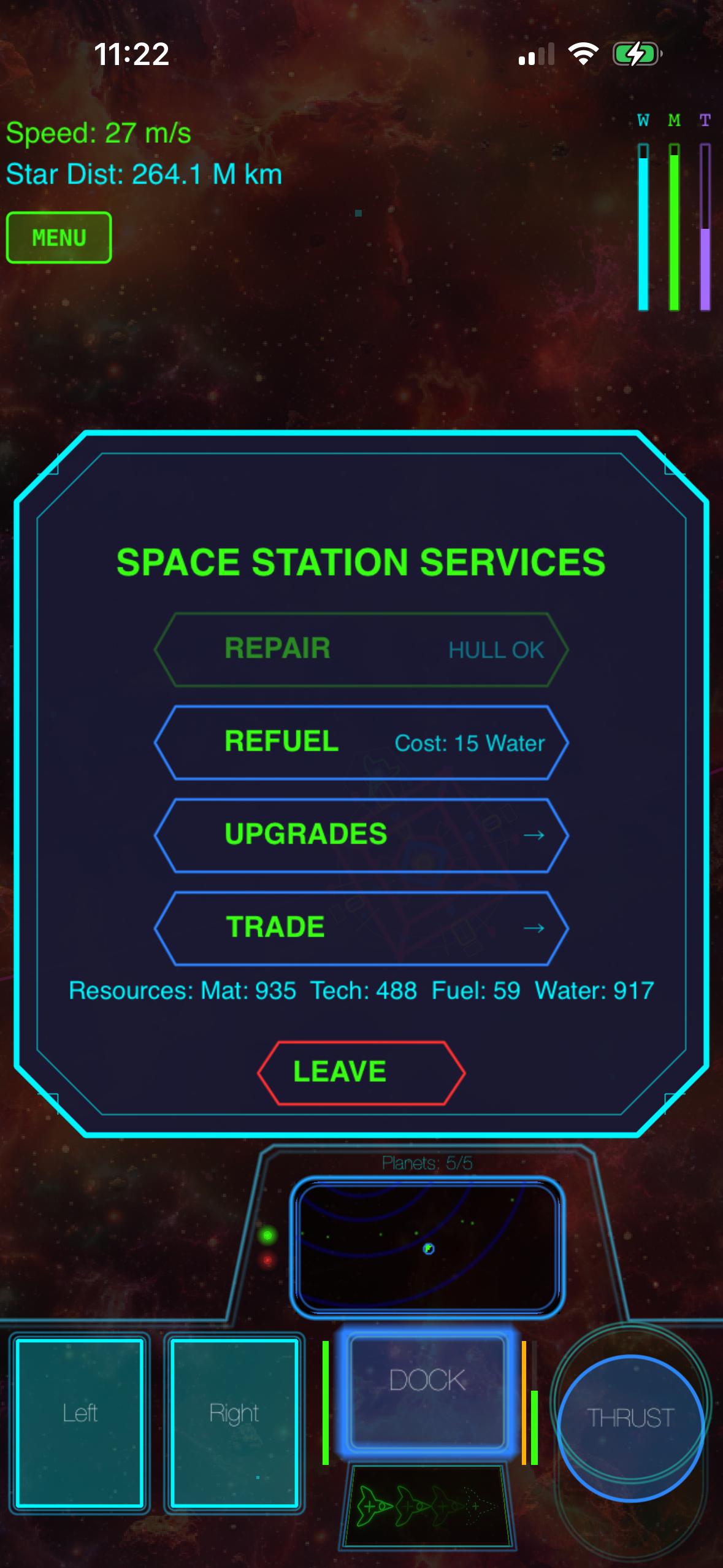
Galaximus proves that real orbital mechanics can power an arcade game, not just a simulator. The ship — The New Dawn — obeys gravity like any other object in space. So do asteroids, planets, and enemy fleets. The learning curve is real (30 minutes of focused play to reach competency), but the payoff is mastery that no faked-physics game can offer.
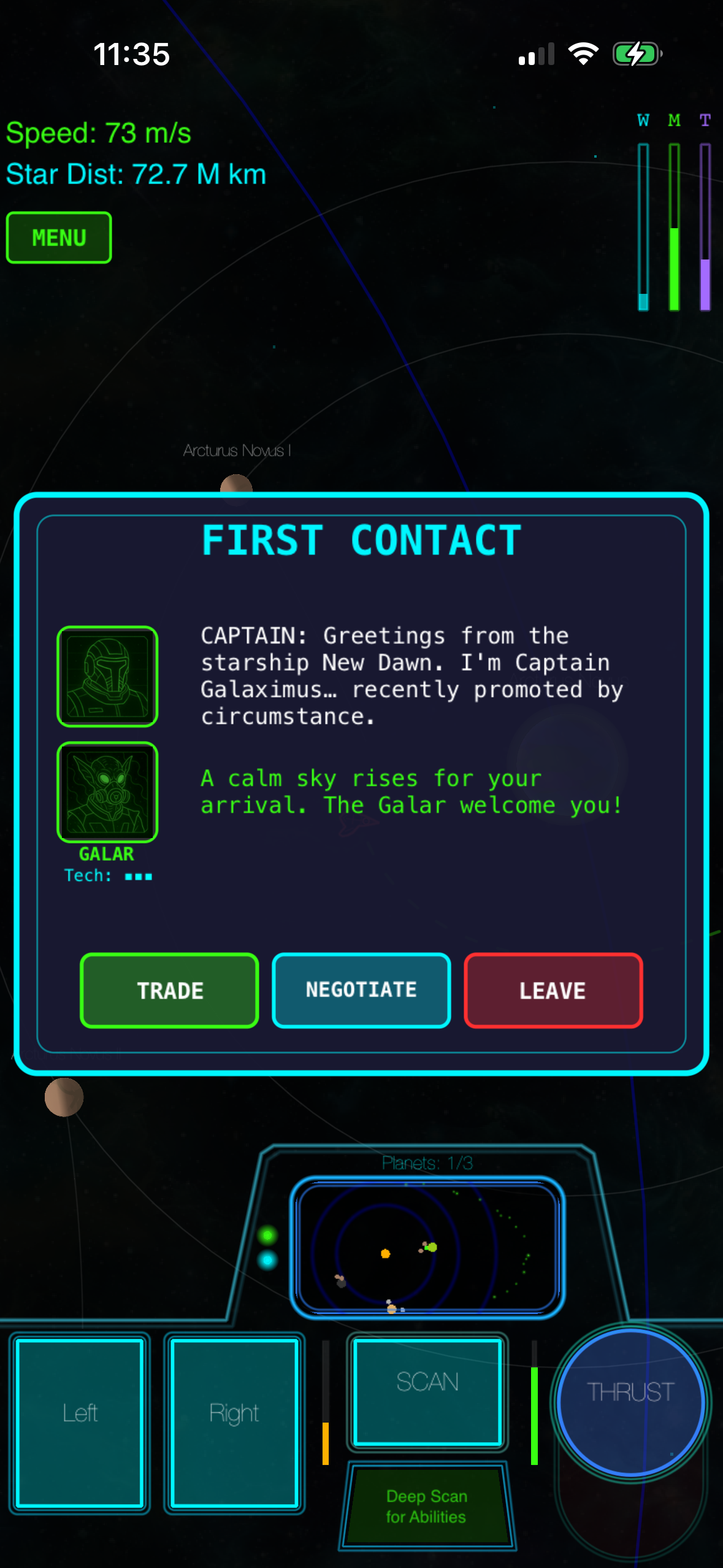
The campaign spans 8 procedurally configured star systems with a structured narrative arc. Each playthrough generates unique planet positions and anomaly placements, so the challenge stays fresh across multiple runs. You’ll encounter 11 different anomaly types — spacetime rifts, derelict ships, distress beacons, and others — each one a self-contained mini-experience that teaches you something about the physics.
Combat is real-time. You’re managing your velocity, reading the gravity field, and positioning for advantage against enemy fleets. The boss fight — the Mirror, a copy of yourself in a spacetime rift — is the campaign’s climax.
Every sound in Galaximus is procedurally synthesized in real time. No pre-recorded audio files. The laser bursts, engine burns, explosions, and alien voices are all generated on the device. It’s technically rare on mobile and aesthetically consistent with the vector-arcade visual style.
Current pricing: Galaximus launches at *. A major expansion called *Galaximus Infinitum ships in late 2026 — open-galaxy sandbox, planetary surface exploration, outpost building, faction warfare. Players who buy Galaximus at the launch tier receive Infinitum as a free upgrade. After Infinitum launches, the combined game moves to ****. If you’re considering it, that timing matters.
Kerbal Space Program: The Engineering Approach
If Galaximus is arcade action with real physics, Kerbal Space Program is the engineering simulator. You’re not piloting a ship; you’re building one.
KSP lets you assemble rockets from individual parts — engines, fuel tanks, heat shields, landing gear, parachutes — and then launch them into a procedurally generated solar system where orbital mechanics are modeled with precision. The depth is staggering. You can spend weeks learning transfer windows, gravity assists, and ascent profiles. The community has built entire wikis around the math.
On iPad: KSP performs smoothly on iPad Air and newer models. On iPhone, performance depends on the device — iPhone 13 and newer handle it well; iPhone 12 and older may experience frame drops during complex builds. Storage requirement is approximately 2.8 GB. This is the full PC version, not a scaled port, so all features and parts are available. iPhone models with less than 4 GB RAM may struggle with large save files.
Where it differs from Galaximus: KSP wants to teach you to think like a rocket engineer. Galaximus wants you to fly. KSP’s learning curve is steeper and longer, but the ceiling is higher. If you want to understand the why behind orbital mechanics, KSP is the game. If you want to feel them intuitively through play, Galaximus is the move.
No Man’s Sky: Exploration at Scale
No Man’s Sky is a different beast entirely. You’re not managing orbital mechanics or building rockets. You’re exploring a procedurally generated universe with billions of planets, each one landable. You walk on surfaces, scan flora and fauna, trade with alien species, build bases, and gradually uncover a narrative about the nature of the universe itself.
The scale is the defining feature. The game generates planets algorithmically; no two are identical. You could play for hundreds of hours and still find new worlds.
Monetization clarity: No Man’s Sky is a one-time purchase with no battle pass, no seasonal content, and no cosmetic IAP. The game has received free major updates since launch — base building, multiplayer, planetary surface improvements, mech suits, and others — funded entirely by the initial purchase price. There are no cosmetics for sale and no premium currency. What you buy is what you get, permanently.
Where it differs from Galaximus: No Man’s Sky is a sandbox with a loose narrative thread. Galaximus is a structured 8-system campaign. NMS is about wandering; Galaximus is about mastery through repetition. NMS has planetary surface exploration built in; Galaximus is adding that in Infinitum. Both are legitimate approaches.
If you want to get lost in a universe, No Man’s Sky delivers that. If you want a focused campaign with a narrative arc, Galaximus fits better.
The Premium Model: Why It Matters in 2026
In 2026, “premium” on the App Store means something specific: one payment, full access, no energy meter, no battle pass, no ads, no in-app purchases.
It’s rare. Most games funded by premium upfront sales have either shut down or pivoted to free-to-play. The ones that remain tend to be either indie titles with small but loyal audiences, or games built by developers who explicitly rejected the free-to-play model.
Galaximus, Kerbal Space Program, and No Man’s Sky all follow this model. You pay once. You own the game. The developers make money if enough players value the experience enough to buy it. That’s a sustainable business model only if the game is genuinely complete and worth the price from day one.
This matters because it aligns the developer’s incentive with the player’s incentive. There’s no engagement metric to hit, no retention curve to optimize. The game is either good enough to be worth the purchase price, or it isn’t.
FAQ
Q: Do I need an internet connection to play these games? A: Galaximus and Kerbal Space Program are fully offline. No Man’s Sky requires an internet connection to generate and sync planets across players, though you can play single-player offline mode if needed.
Q: What’s the typical playtime per session for each game? A: Galaximus campaigns run 45 minutes to 2 hours depending on difficulty and how much you explore. Kerbal Space Program sessions are open-ended — you can spend 15 minutes testing a design or 4 hours planning a mission. No Man’s Sky has no session limit; you can play for 10 minutes or 10 hours in a single sitting.
Q: Do these games work on older iPhone models? A: Galaximus and No Man’s Sky run on iPhone 11 and newer. Kerbal Space Program requires iPhone 13 or newer for stable performance; iPhone 12 and older will experience frame drops and may crash with large save files. All three require iOS 14 or later.
Q: Can I play these games on iPad? A: Yes, all three are optimized for iPad. Kerbal Space Program and No Man’s Sky especially benefit from the larger screen for UI and readability.
Q: Will Galaximus Infinitum be free if I buy now? A: Yes. The expansion is free for anyone who purchases Galaximus at the launch tier. Once Infinitum launches later in 2026, the combined game moves to. This is a real time-limited offer.
Q: Are there any other paid space games worth considering? A: The market is thin. A few smaller titles exist — Spaceflight Simulator, Gravitas — but they’re either narrower in scope or less polished than the three above. The paid space game space on iOS is genuinely small in 2026.
The Bottom Line
If you want a paid space game on iPhone in 2026, you’re choosing between three distinct experiences: arcade action with real physics (Galaximus), engineering simulation depth (Kerbal Space Program), or exploration sandbox scale (No Man’s Sky).
All three are complete, polished, monetization-free, and worth the purchase price. The choice depends on what you actually want to do in space. Learn to fly? Build rockets? Explore? Pick the one that matches your answer.
Get Galaximus on the App Store: Get it on the App Store

