Top-Rated Paid Space Games on App Store 2026
 by Galaximus

Photo by Esteban Lafargue on Unsplash
The Best Paid Space Games for iPhone in 2026
The App Store’s free-to-play model dominates, but a small, devoted segment of iPhone gamers still wants what premium games deliver: a complete experience you buy once, no energy timers, no battle passes, no ads interrupting gameplay. If you’re searching for paid space games that respect your time and wallet, the 2026 selection offers genuine variety.
We’ve evaluated the top-rated offerings across 2026 to show you what’s worth buying. Whether you want arcade-action physics, engineering depth, narrative-driven exploration, or procedural discovery, the premium space-game category now has options that didn’t exist five years ago.
Why Premium Space Games Stand Out in 2026
The free-to-play treadmill has created a misalignment: the more polished a space game looks, the more likely it’s designed to extract ongoing spending. Premium games flip that incentive. You pay once—typically —and the developer’s goal becomes making the experience complete, not endless.
Paid space games tend to:
- Ship with a beginning, middle, and end. No soft launches waiting for content drops years later.
- Respect your attention span. No notifications nagging you to log in. No artificial scarcity forcing you to wait for timers.
- Prioritize mastery over monetization. The game is engaging because it’s well-designed, not because it’s engineered to be addictive.
The tradeoff is real: you won’t find the massive multiplayer scope of free-to-play titles. You get something rarer—a focused artistic vision.
The Top Paid Space Games Compared
Galaximus ($19.99)
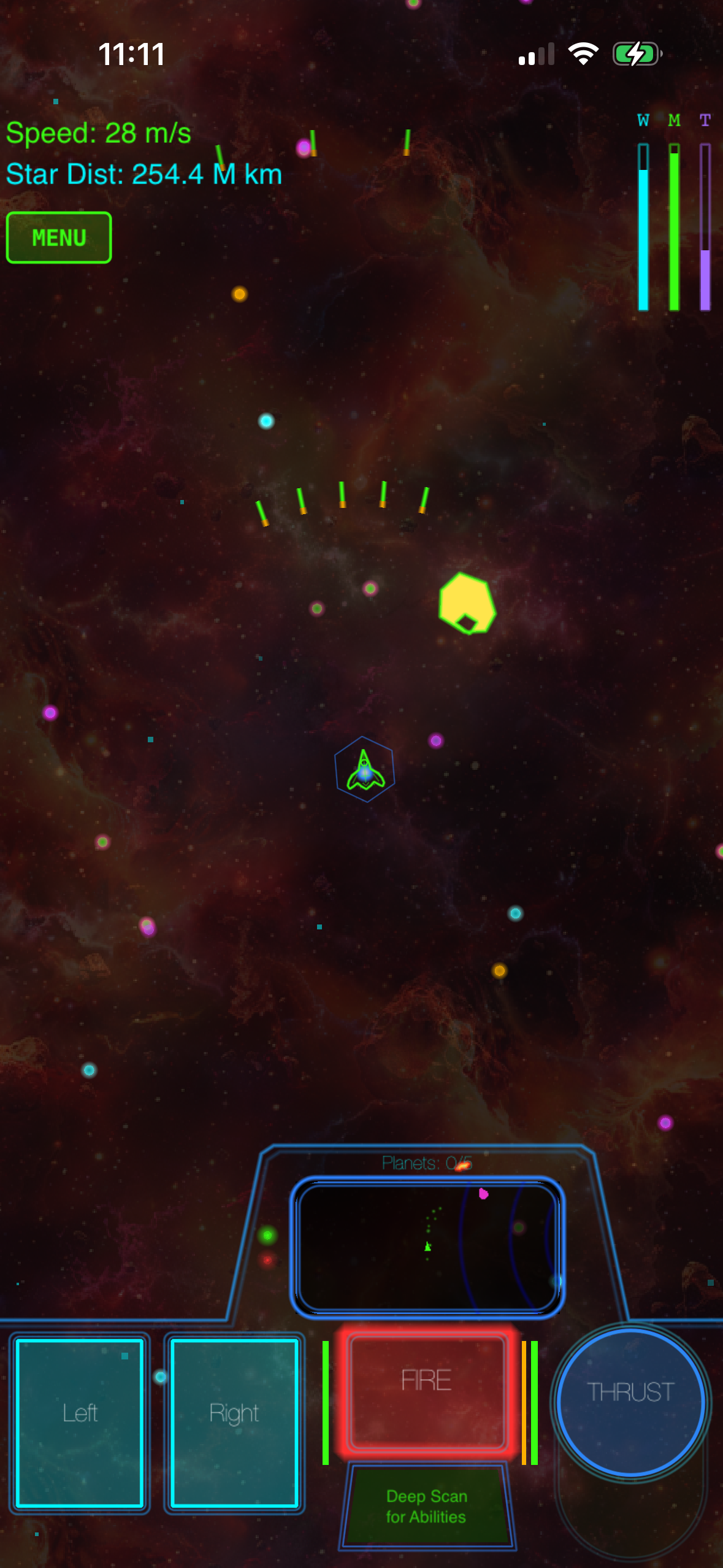
Galaximus is built on real orbital mechanics—planets orbit suns, moons orbit planets, and your ship obeys gravity. The core mechanic is the gravity slingshot: you use a planet’s gravity well to gain speed for free, then plot your course. Mastery comes within 30 minutes of focused play.
The campaign spans eight star systems with a structured narrative arc. Procedural configuration means planets and anomalies shuffle each playthrough, but the story shape is authored—you’ll encounter 11 encounter types (spacetime rifts, derelict ships, distress beacons, alien fleets) and a boss fight against the Mirror. This is not procedural generation that breaks narrative continuity; planets change cosmetically, but story beats remain consistent.
Audio is procedurally synthesized in real time—every laser, explosion, and alien voice is generated on-device, creating a cohesive aesthetic. No ads, no IAP, no energy meters. Typical campaign length: 5–10 hours. Early buyers receive Galaximus Infinitum (planetary surface exploration, outpost building, faction warfare) as a free upgrade when it ships late 2026; after launch, the combined game moves to a higher price tier.
Get Galaximus: [App Store link]
Kerbal Space Program Mobile ($34.99)
KSP Mobile is the gold standard for engineering depth. You build rockets from components, calculate orbital burns, and learn rocket science through gameplay. The learning curve is steep—you’re learning actual physics, not just flying—and that’s intentional. If you want to understand every variable in your orbital calculations, KSP is the only game that delivers.
Typical playtime: open-ended, with players investing 50–200+ hours. Single-player only. Works offline.
No Man’s Sky (Mobile via Cloud Streaming)
No Man’s Sky offers procedural planet exploration at a scale neither Galaximus nor KSP attempt. You can walk on planet surfaces, discover alien species, build bases, and engage in space combat. The procedural generation here is extensive—billions of planets exist, each unique. This is exploration-focused, not narrative-driven.
Availability: cloud streaming (PlayStation Plus Premium, Xbox Game Pass) or native port status varies by region and update. Confirm current availability on your App Store before purchasing.
Asteroids-Style Arcade Games ($2.99–$9.99)
Vector-graphics descendants of the 1979 Asteroids classic remain popular for pure arcade action. Games in this category (e.g., Lunar Lander clones, vector-based shooters) are instantly fun, require no learning curve, and work well for 5–15 minute sessions. The tradeoff is depth—you’re refining reflexes, not learning a new skill.
Pricing and Availability Summary
| Game | Price | Campaign Length | Learning Curve | Offline Play |
|---|---|---|---|---|
| Galaximus | 5–10 hours | Moderate | Yes | |
| Kerbal Space Program Mobile | Open-ended (50–200+ hours) | Steep | Yes | |
| No Man’s Sky (mobile) | Varies (cloud streaming included with subscription; native port pricing TBA) | Open-ended | Low | Depends on platform |
| Asteroids-style games | N/A (arcade) | None | Yes |
What to Look For in a Paid Space Game
Before you buy, consider:
-
Do I want a learning curve, or instant gratification? Games with real physics (Galaximus, KSP) require 20–30 minutes to feel natural. Arcade games are fun immediately.
-
Do I want a complete story, or open-ended exploration? Galaximus and similar titles have a beginning and end. No Man’s Sky and sandbox titles are endless.
-
How important is offline play? Most premium space games work offline. Cloud-streaming titles require a connection. If you play on planes or in areas without signal, check the game’s requirements.
-
What’s my budget? Arcade games start at. Mid-tier narrative games run. Engineering simulators like KSP+. All are one-time purchases with no IAP.
FAQ
Can I refund a paid space game if I don’t like it?
Yes. Apple allows refunds within 14 days of purchase if you haven’t downloaded the game, or within 14 days of download if you request a refund through App Store settings (Settings > [Your Name] > Media & Purchases > Purchase History). Some developers may offer refunds beyond Apple’s window if you contact them directly.
Do these games work on iPad?
Most do. Galaximus, Kerbal Space Program Mobile, and most Asteroids-style games are universal apps (iPhone + iPad). No Man’s Sky’s mobile availability varies by platform. Check the App Store listing for “Requires iPad” or “Universal” designation before purchasing.
What’s the minimum iOS version required?
Requirements vary by game. Galaximus requires iOS 14.0+. Kerbal Space Program Mobile requires iOS 13.0+. Asteroids-style games typically require iOS 12.0+. Check the App Store listing under “Information” > “Requires iOS [version] or later” before buying.
Do I need an internet connection to play?
Most premium space games work offline. Galaximus is fully playable without a connection. Kerbal Space Program Mobile works offline. No Man’s Sky (cloud streaming) requires internet; native ports may vary. Asteroids-style games work offline. Check the specific game’s requirements if online features matter to you.
What’s the difference between Galaximus and Kerbal Space Program?
Galaximus is arcade-action with real physics underneath—you pilot a ship and use gravity as your engine. It has a narrative arc and is designed for 5–10 hour campaigns. Kerbal Space Program is an engineering simulator where you build rockets and learn orbital mechanics from first principles. It’s open-ended and can consume hundreds of hours. Both use real physics; they serve different players.
Will Galaximus Infinitum cost extra if I buy now?
No. If you buy Galaximus at, you’ll receive Infinitum as a free upgrade when it ships in late 2026. After Infinitum launches, the combined game will move to a higher price tier. This is a genuine early-adopter advantage.
The Premium Space Game Moment
2026 is a good year to be selective about space games. The free-to-play market is oversaturated and increasingly extractive. The premium category is small enough that every title has to be genuinely good to survive. Developers can’t rely on engagement manipulation or FOMO mechanics—they have to ship something worth the asking price.
That constraint produces clarity. You know what you’re getting: a finished game, no surprises, no hidden costs, no ongoing spending pressure.
Whether you want real orbital mechanics, engineering depth, narrative-driven exploration, or pure arcade action, the paid space-game shelf in 2026 has options that respect your intelligence and your wallet.